


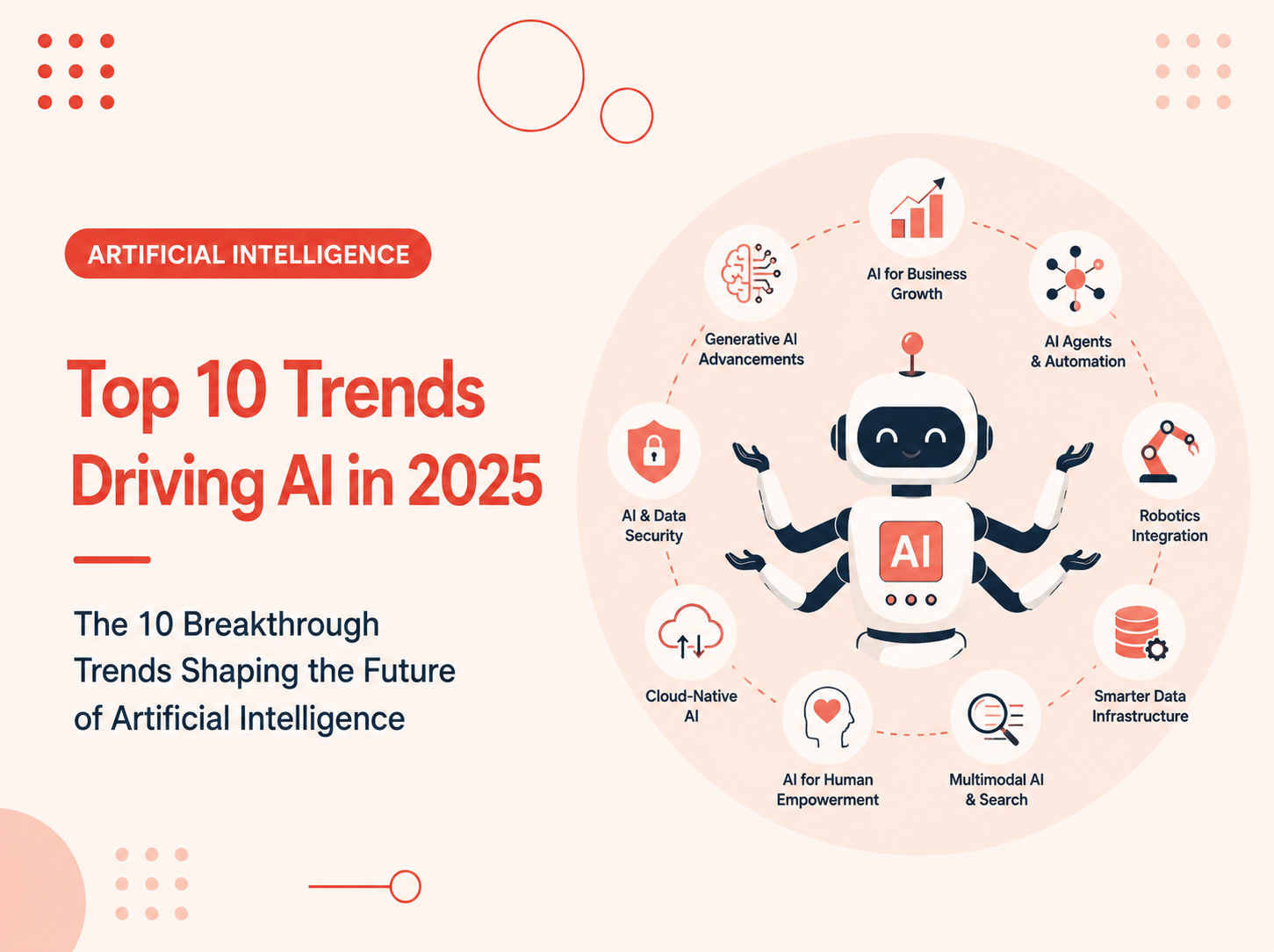
As the world continues to evolve at a breathtaking pace, Artificial Intelligence in 2025 is steering the next wave of digital transformation. No longer confined to tech labs and sci-fi novels, AI is now influencing how we shop, work, heal, learn, and even socialize.
But what exactly is driving this evolution? What new trends are emerging in the world of Artificial Intelligence in 2025? And more importantly, how will they shape the future?
In this blog, we dive into the top 10 trends defining the landscape of Artificial Intelligence in 2025, and how businesses and individuals alike can prepare.
1. Human-AI Collaboration Becomes Mainstream
In 2025, we’re witnessing a shift from automation to augmentation. Rather than replacing humans, AI now works with them.
In offices, AI assists with decision-making, content creation, and data analysis.
In factories, cobots (collaborative robots) work side-by-side with human workers.
In healthcare, AI helps doctors make faster and more accurate diagnoses.
The rise of Artificial Intelligence in 2025 is not about competition—it’s about partnership.
2. Hyper-Personalization Through AI
Personalization has reached a whole new level thanks to Artificial Intelligence in 2025:
E-commerce platforms adapt product offerings based on real-time behavior.
Music and video streaming services predict mood and suggest content accordingly.
Smart homes learn daily routines and adjust lighting, temperature, and energy use.
AI uses massive data points to build highly detailed user profiles, delivering individualized experiences like never before.
3. AI Regulation and Ethical Frameworks
As Artificial Intelligence in 2025 becomes more powerful, so does the need to regulate it. Governments and organizations are:
Creating frameworks for ethical AI development.
Mandating transparency in AI decision-making.
Requiring human oversight in critical areas like healthcare and justice.
Ethical AI is no longer optional—it’s a global priority.
4. AI-Driven Content Creation Explodes
Generative AI is now one of the most exciting frontiers in tech. With tools like ChatGPT, DALL·E, and Sora, Artificial Intelligence in 2025 can:
Write articles, stories, and reports.
Generate artwork and logos.
Compose music or design videos.
This has led to a surge in creativity and productivity, especially among solo creators, marketers, and startups.
5. Smarter, More Autonomous Vehicles
In the transportation sector, Artificial Intelligence in 2025 is the engine behind:
Safer self-driving cars and delivery drones.
AI traffic control systems to ease congestion.
Intelligent public transport systems that adapt to demand in real-time.
Autonomous vehicles are no longer experiments—they’re on the streets, in the skies, and reshaping how we move.
6. Revolutionizing Customer Service
AI chatbots and virtual agents have gone from frustrating to fantastic. With Artificial Intelligence in 2025, customer service is:
Available 24/7 across multiple languages.
Highly responsive and emotionally intelligent.
Able to resolve 80% of basic queries without human help.
Many companies now use AI to handle their entire support funnel—reducing costs and increasing customer satisfaction.
7. AI in Education and Upskilling
Artificial Intelligence in 2025 is helping redefine how we learn:
Smart tutors adjust lessons based on student performance.
AI platforms recommend personalized study paths and content.
Language learning apps use real-time voice and grammar correction.
Educators are now using AI to bridge learning gaps, making education more accessible and inclusive.
8. Cybersecurity Powered by AI
With threats becoming more sophisticated, Artificial Intelligence in 2025 plays a crucial role in:
Detecting anomalies and potential breaches before they occur.
Automating threat responses.
Managing complex networks and security protocols without human error.
AI-powered cybersecurity tools are essential to defending personal, corporate, and national infrastructure.
9. AI Democratization and No-Code Tools
The rise of no-code and low-code AI tools means Artificial Intelligence in 2025 is no longer just for developers:
Business analysts can create dashboards with AI predictions.
Designers can use AI to generate visual assets.
Marketers can build AI-powered chatbots and automations.
The barrier to entry is lower than ever—unlocking innovation across every industry.
10. Sustainable AI and Green Tech
AI is also helping save the planet. In 2025, AI is being used to:
Optimize energy grids and reduce waste.
Predict climate patterns and natural disasters.
Monitor and improve agricultural practices for sustainability.
As the climate crisis intensifies, Artificial Intelligence in 2025 is emerging as a green tech enabler.
Final Thoughts: The Age of Responsible Intelligence
It’s clear that Artificial Intelligence in 2025 is more than just a tool—it’s a transformational force. Across industries, it’s enabling smarter decisions, faster innovation, and greater inclusivity.
But with this power comes responsibility. Building ethical, transparent, and human-centered AI systems is now a shared global mission. Whether you’re a student, entrepreneur, developer, or policymaker—understanding AI and how to use it wisely is essential.
The future is not AI versus humans—it’s AI with humans, building a smarter and more connected world.