


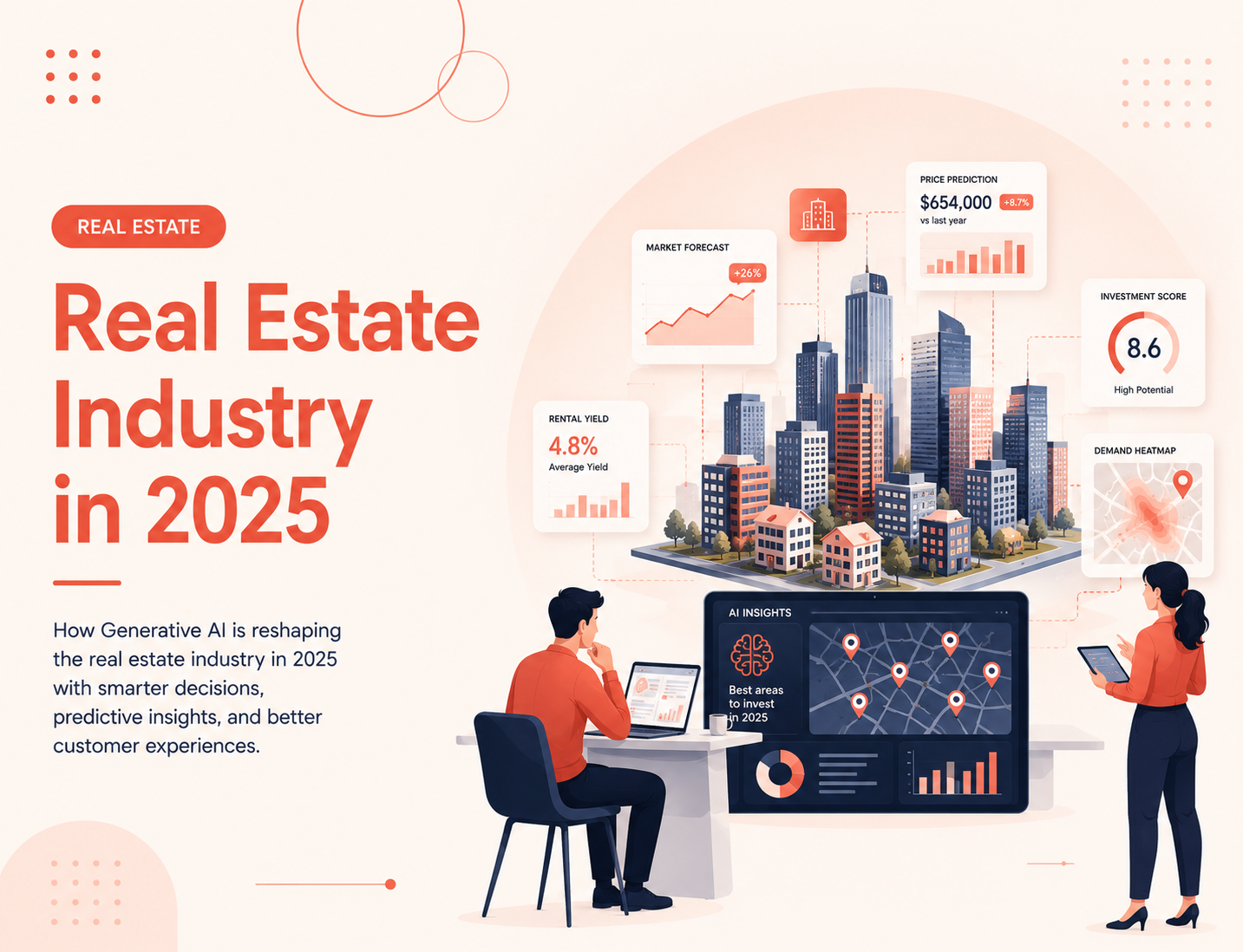
How Generative AI Is Reshaping the Real Estate Industry – 2025 Guide
The real estate industry has always been dynamic, constantly evolving with market conditions, consumer expectations, and technological advancements. However, one technology is creating a seismic shift — Generative AI in Real Estate.
From creating photorealistic property images without a camera to predicting future housing prices with remarkable accuracy, Generative AI is fundamentally transforming how agents, developers, investors, and buyers interact with the property market.
This is not just another tech trend; it’s a revolution in the making. In this guide, we’ll explore how Generative AI in Real Estate is shaping the industry, with real-world examples, benefits, challenges, and predictions for the future.
What Is Generative AI in Real Estate?
Generative AI is a branch of artificial intelligence that uses machine learning models to create new content — whether that’s images, 3D environments, videos, text, or even architectural designs. Unlike traditional AI, which focuses on analyzing and interpreting data, Generative AI produces new, unique outputs based on learned patterns.
In real estate, this means AI can:
Generate stunning property renderings from floor plans.
Create realistic virtual tours for off-plan properties.
Draft compelling and personalized property listings.
Predict future property values with unprecedented precision.
Build immersive, interactive customer experiences.
The Rise of Generative AI in Real Estate
The adoption of Generative AI in Real Estate has accelerated due to three key factors:
Data Availability – Real estate platforms now have vast datasets of images, prices, market trends, and customer behavior.
Advances in AI Models – Technologies like DALL·E, Midjourney, Stable Diffusion, and GPT-4 can create lifelike visuals and human-like copy instantly.
Consumer Expectations – Today’s buyers expect personalization, instant access to property details, and immersive experiences.
1. Enhancing Property Visualization
Before AI:
Developers spent thousands of dollars on architectural renderings, photography, and staging.
With Generative AI:
AI can take a floor plan and generate a photorealistic image or 3D walkthrough in minutes.
AI Virtual Staging: Empty rooms can be digitally furnished to match buyer preferences.
Multiple Styles: One property can be shown in modern, rustic, or minimalist styles instantly.
Day & Night Views: AI can generate variations with different lighting conditions.
📌 Example: A developer in New York used AI to create visuals for a luxury apartment building before it was built. This helped pre-sell 60% of units in under two months.
2. Personalized Property Recommendations
Personalization is the heart of modern customer service. Generative AI in Real Estate analyzes a user’s search history, lifestyle preferences, and budget to recommend properties that feel handpicked.
Neighborhood Matching: AI recommends areas based on commute time, school ratings, or cultural fit.
Preference Learning: If a buyer likes waterfront views, AI prioritizes similar listings.
Dynamic Updates: Recommendations change as market conditions or user needs shift.
3. Revolutionizing Real Estate Marketing
Marketing is resource-intensive — photoshoots, content writing, social media updates, and ad creation. Generative AI can handle much of this automatically.
AI-Generated Listing Descriptions: Tailored to appeal to the target audience and optimized for SEO.
Social Media Campaigns: AI creates visually engaging posts with captions.
Email Campaigns: Personalized outreach that addresses a client’s specific needs.
📌 Case Study: A California brokerage used AI to automate listing descriptions, reducing content creation time from 3 days to 3 hours while increasing inquiries by 35%.
4. AI-Powered Property Valuation
Accurate property pricing is critical. Generative AI in Real Estate leverages massive datasets, including:
Comparable recent sales.
Location and neighborhood trends.
Local amenities and upcoming infrastructure.
Seasonal demand patterns.
The AI doesn’t just give a static number; it provides scenario-based pricing predictions, helping both buyers and sellers make informed decisions.
5. Automating Legal and Administrative Processes
Real estate involves a mountain of paperwork — contracts, lease agreements, disclosures. AI can draft, review, and summarize these documents.
Drafting Contracts: AI generates standard agreements tailored to local regulations.
Document Review: Flags missing clauses or inconsistencies.
Summarization: Creates simplified explanations for clients unfamiliar with legal jargon.
6. Predicting Market Trends and Investment Opportunities
Market intelligence is no longer just for big investors. With Generative AI in Real Estate, even small agencies can:
Identify high-growth neighborhoods.
Forecast rental yield trends.
Predict demand for specific property types.
📌 Example: An AI model predicted a surge in demand for mid-sized apartments in Austin, Texas, six months before it happened — giving early investors a major edge.
7. AI-Powered Virtual Assistants
Imagine a 24/7 assistant that:
Answers property-related questions instantly.
Schedules property tours.
Calculates mortgage payments.
Updates clients on market conditions.
With Generative AI in Real Estate, chatbots and voice assistants can handle most client inquiries, freeing up agents for high-value interactions.
8. Transforming Architecture and Urban Planning
Generative AI isn’t just for sales — it’s also influencing property design.
AI-Designed Floor Plans: Optimized for light, space, and functionality.
Sustainable Design Suggestions: AI incorporates eco-friendly materials and layouts.
City Planning: AI models help predict the impact of new developments on traffic, population density, and utilities.
9. Benefits of Generative AI in Real Estate
Time Savings: Instant property visuals, pricing, and content creation.
Cost Efficiency: Reduced need for expensive staging and photography.
Better Customer Experience: Personalized, data-driven recommendations.
Competitive Edge: Early adopters can dominate niche markets.
Data-Driven Accuracy: More precise pricing and forecasting.
10. Challenges and Ethical Concerns
Bias in AI Models: Poorly trained models can perpetuate discrimination in property recommendations.
Data Privacy: Handling sensitive buyer data securely is critical.
Over-Reliance on AI: Real estate is still a relationship business — human touch matters.
Regulatory Compliance: AI-generated valuations must comply with local laws.
11. Future Trends of Generative AI in Real Estate
The next 5–10 years could see:
AI-Powered Blockchain Transactions: Secure, instant, transparent property transfers.
Augmented Reality House Hunting: View AI-generated renovations while touring a home in person.
AI-Driven Smart Contracts: Automatically release payments when contract conditions are met.
AI-Generated Neighborhood Simulations: See projected community growth before buying.
12. How Real Estate Professionals Can Adopt Generative AI
Start Small: Use AI for listing descriptions or virtual staging first.
Train Your Team: Educate staff on how to integrate AI tools.
Partner with AI Vendors: Leverage proven solutions like ChatGPT, Midjourney, and Zillow’s AI tools.
Monitor ROI: Track leads, conversions, and customer feedback to measure success.
Conclusion
Generative AI in Real Estate is transforming the property market in ways we couldn’t have imagined a decade ago. From breathtaking visualizations and tailored recommendations to precise valuations and market forecasts, AI is empowering professionals to work smarter, faster, and more creatively.
While challenges like data privacy and AI bias remain, the opportunities are too significant to ignore. In 2025 and beyond, those who embrace Generative AI in Real Estate will have a decisive edge over the competition.