


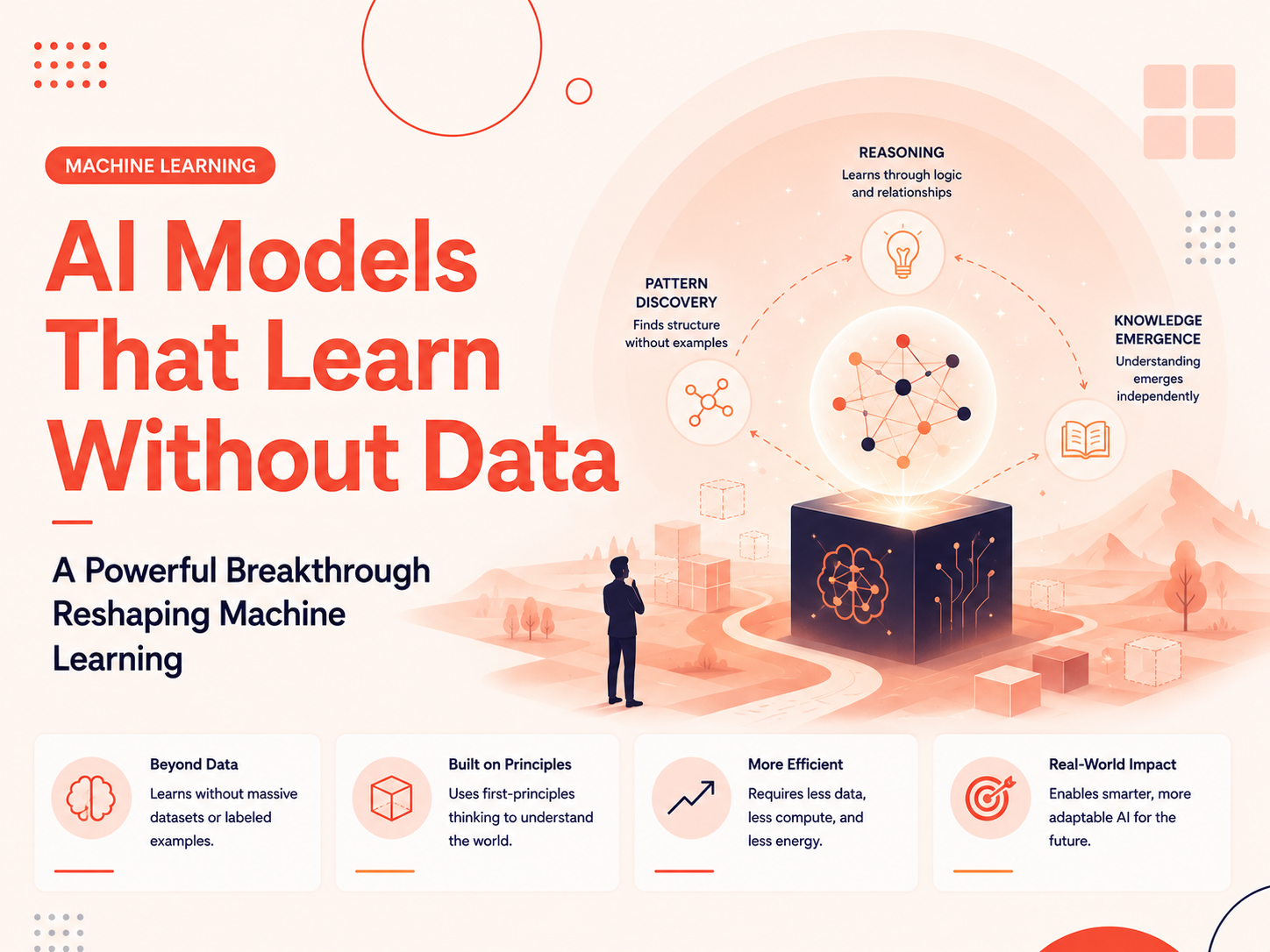
Introduction: The End of the Data Obsession
For over a decade, machine learning has been driven by one assumption: more data equals better intelligence. In 2026, that assumption is beginning to break.
A new class of systems—AI models that learn without traditional data—is emerging. These models rely less on massive datasets and more on reasoning, simulation, self-play, and internal world models. This shift marks one of the most important breakthroughs in the future of AI.
What Does “Learning Without Data” Really Mean?
Learning without data does not mean learning from nothing. Instead, it means:
- Minimal or zero labeled datasets
- No dependence on large real-world data collection
- Learning through internal generation, simulation, and inference
These systems create their own learning environments rather than relying on historical data.
The Technologies Making It Possible
1. World Models
AI builds an internal representation of how the world works and tests decisions inside that simulated reality.
2. Synthetic Experience Generation
Instead of collecting data, the model generates scenarios, outcomes, and counterfactuals on its own.
3. Self-Play and Recursive Learning
Models improve by competing against themselves, identifying weaknesses, and refining strategies.
4. Reasoning-First Architectures
Logic, abstraction, and planning take priority over pattern matching.
Why This Is a Major Machine Learning Breakthrough
Faster Model Development
No long data collection cycles.
Lower Cost
Reduced dependence on expensive datasets and labeling pipelines.
Privacy by Design
No personal or sensitive user data required.
Better Generalization
Models learn principles, not just correlations.
Real-World Applications Emerging in 2026
Robotics
Robots learn tasks in simulations before touching the physical world.
Healthcare
AI models reason about diagnoses without relying on patient data histories.
Finance
Risk modeling through scenario simulation rather than past market data.
Software Engineering
AI systems learn system behavior instead of training on source code repositories.
How This Changes the Role of ML Engineers
The focus shifts from:
- Data collection → Behavior design
- Feature engineering → Environment modeling
- Dataset tuning → Constraint definition
ML engineers become architects of intelligence, not data wranglers.
Challenges and Limitations
- Ensuring realism in simulations
- Preventing logical hallucinations
- Verifying decisions without historical benchmarks
- Regulatory acceptance
Despite these challenges, progress is accelerating.
Is Data-Driven ML Becoming Obsolete?
No. Traditional data-driven models will coexist with data-light systems. However, for many domains, data will no longer be the bottleneck.
How to Prepare for This Shift
- Learn reinforcement learning and planning models
- Study simulation environments
- Focus on reasoning and decision-making frameworks
- Understand AI safety and evaluation techniques
Evaluation and Validation Without Historical Data
One of the most challenging aspects of AI models that learn without data is evaluation. Traditional ML relies on test datasets and benchmarks. Data-light AI systems instead require:
- Simulation-based stress testing
- Adversarial scenario generation
- Constraint satisfaction checks
- Human-in-the-loop auditing
Evaluation becomes a continuous process rather than a one-time metric.
Governance, Safety, and Alignment
As these models gain autonomy, governance becomes critical:
- Hard constraints to prevent unsafe actions
- Alignment layers ensuring goals match human intent
- Decision traceability for audits and compliance
- Fail-safe degradation when uncertainty is high
Regulators are increasingly focusing on how models reason, not just outputs.
Industry Impact: Winners and Losers
Who Benefits Most
- Startups without access to large datasets
- Privacy-sensitive industries (healthcare, defense)
- Edge and offline-first applications
Who Faces Disruption
- Data labeling companies
- Dataset marketplaces
- Data-heavy ML pipelines
The competitive advantage shifts from data ownership to intelligence design.
Open Source vs Proprietary Approaches
Open-source communities are experimenting with:
- Simulation frameworks
- Reasoning engines
- Self-play environments
Meanwhile, enterprises are building proprietary world models tailored to their domains. The divide mirrors early cloud vs on-prem debates.
What This Means for the Future of AI Education
Curricula will shift toward:
- Systems thinking
- Cognitive architectures
- Ethics and alignment
- Environment and behavior design
Students will learn why intelligence works, not just how to train it.
Final Thoughts
AI models that learn without data are not a replacement for traditional machine learning—they are an evolution of it. By reducing dependence on historical data, these systems unlock faster innovation, stronger privacy, and more adaptable intelligence.
The future of AI will not be defined by who has the most data, but by who understands intelligence the best.
FAQs
Q: Are these models truly data-free?
They minimize reliance on external datasets but still use structured priors and rules.
Q: Will this replace deep learning?
No. It extends and complements existing approaches.
Q: Is this technology production-ready?
Early-stage adoption is underway, with rapid advancement expected through 2026.