


Introduction
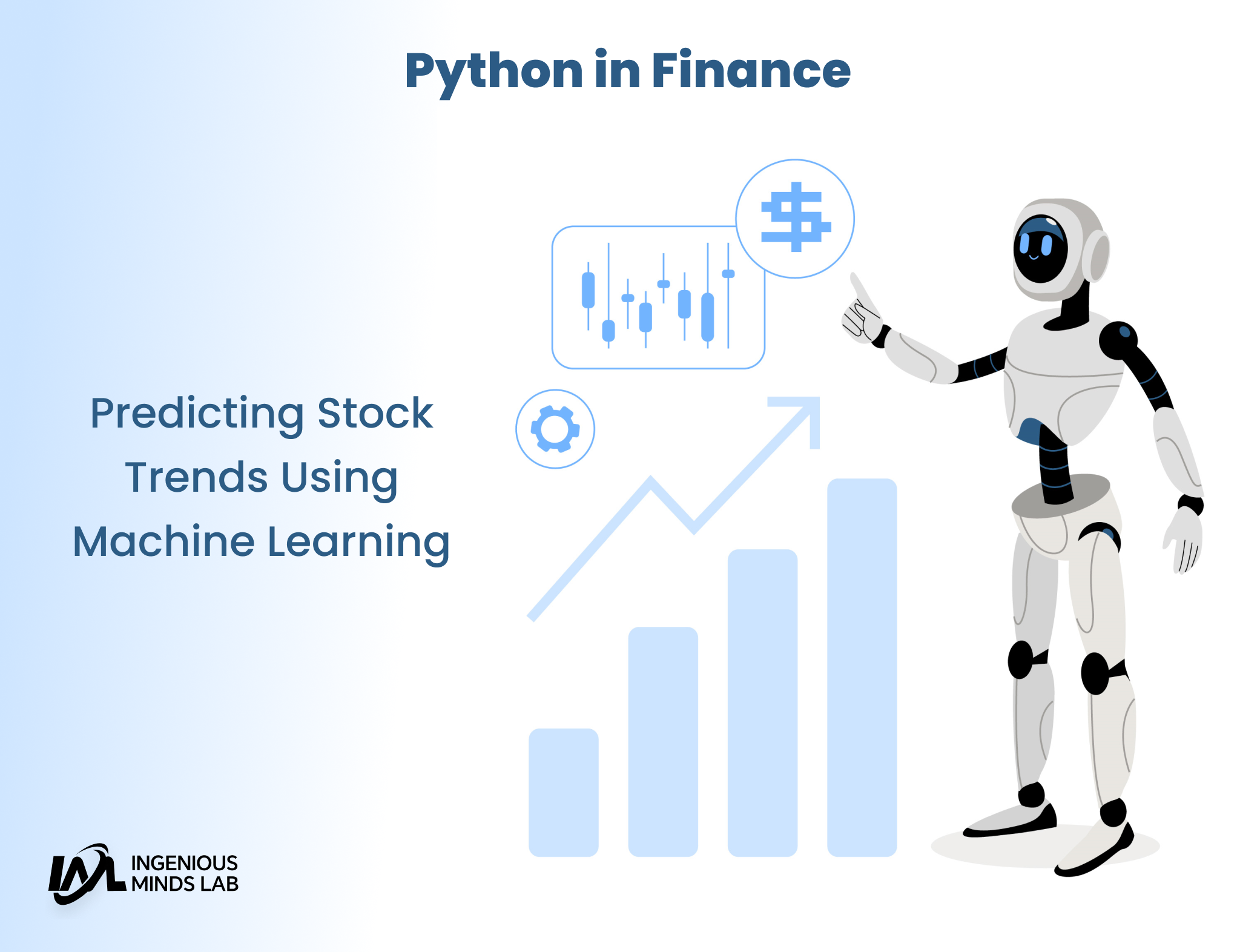
In today’s data-driven world, Python has become the backbone of financial analytics. With its simplicity, flexibility, and vast ecosystem of machine learning libraries, Python is transforming how investors predict, analyse, and automate stock trading decisions.
From predicting stock prices to building AI-powered trading bots, Python in finance is no longer a buzzword — it’s the new reality of smart investing. Let’s explore 5 powerful ways Python and Machine Learning are revolutionising stock trend prediction in 2025.
1. Predicting Stock Prices with Regression Models

One of the most common uses of Python in finance is building predictive models that forecast stock prices.
With libraries like scikit-learn, TensorFlow, and XGBoost, data scientists train regression algorithms such as:
Linear Regression — for simple trend predictions
LSTM (Long Short-Term Memory) — for time-series forecasting
Random Forests — for capturing complex, nonlinear patterns
For example, an analyst can use historical stock data, moving averages, and trading volume to train a model that predicts future prices with surprising accuracy.
2. Sentiment Analysis of Financial News
In 2025, market sentiment drives volatility more than ever. Python’s natural language processing (NLP) tools like spaCy, NLTK, and Hugging Face Transformers help investors analyse financial news, social media posts, and tweets to gauge public mood.
By assigning a sentiment score to each piece of text, machine learning models can detect bullish or bearish signals — helping traders make faster, more informed decisions.
💡 Example: A sudden rise in positive sentiment around Tesla or Apple stock can signal potential upward movement before the market reacts.
3. Algorithmic Trading with Python

Algorithmic or “algo” trading uses Python scripts to automatically execute trades based on predefined conditions.
Frameworks like Backtrader, Zipline, and QuantConnect allow traders to:
Backtest strategies on historical data
Execute real-time trades via APIs
Optimize algorithms for profit and risk
Python’s integration with broker APIs (e.g., Alpaca, Interactive Brokers) enables real-time execution, reducing emotional trading and human error.
🚀 The result? Faster, data-backed trades that respond instantly to market movements.
4. Feature Engineering and Data Visualisation

Before predicting stock trends, data scientists use Python to clean, process, and visualise massive datasets.
Popular tools:
Pandas — for cleaning and managing financial data
Matplotlib & Seaborn — for visualising stock performance and correlations
NumPy — for numerical computations
Data visualisation reveals hidden market patterns like seasonality or sudden anomalies, which machine learning models use to boost accuracy.
📊 Example: A heat-map showing sector correlations can help investors diversify portfolios strategically.
5. Reinforcement Learning for Trading Bots
The most advanced use of Python in finance involves reinforcement learning (RL) — where AI agents learn from market actions and rewards.
Libraries like TensorFlow Agents (TF-Agents) and Stable Baselines3 enable developers to create self-learning trading bots that:
Continuously adapt to market changes
Minimise losses during volatility
Improve decision-making based on feedback
In 2025, RL-based bots are leading the way in autonomous trading systems that outperform traditional models.
Real-World Example
JP Morgan, Goldman Sachs, and Bloomberg already use Python-powered ML systems to automate risk analysis, portfolio optimization, and trade execution. Startups and retail investors are following the same trend using Google Colab, Yahoo Finance API, and Kaggle datasets to build their predictive models.
Benefits of Using Python in Financial Forecasting
- High accuracy through ML and AI models
- Automation of complex trading decisions
- Scalability across massive datasets
- Transparency with easy-to-read scripts
- Community support from thousands of open-source contributors
Frequently Asked Questions (FAQs)
1. Why is Python preferred in finance?
Python’s readability, versatility, and rich ecosystem of data science libraries make it ideal for financial analytics, automation, and predictive modeling.
2. Can Python really predict stock market movements?
While no model can predict the market perfectly, Python-based ML models can detect patterns, sentiment, and correlations that enhance decision accuracy.
3. What are the best libraries for financial ML projects?
Top libraries include scikit-learn, TensorFlow, Keras, Pandas, NumPy, and Matplotlib.
4. Is Python used in professional trading firms?
Yes — most hedge funds, fintech startups, and major banks use Python for building, testing, and deploying trading strategies.
5. How can beginners start with financial ML?
Start by learning Python basics, explore data from Yahoo Finance, and build simple regression or sentiment models using scikit-learn.
Conclusion
In 2025, Python in finance is more than a trend — it’s a strategic advantage. With the rise of machine learning, investors can now analyse complex datasets, predict market shifts, and automate decisions faster than ever before.
Whether you’re a data scientist, trader, or tech enthusiast, mastering Python for financial analysis opens the door to the future of intelligent investing.