


Introduction
In 2025, mobile app development has become faster, smarter, and more connected than ever. Flutter continues to dominate the cross-platform space — allowing developers to build high-performance apps for Android, iOS, web, and desktop with a single codebase.
But here’s the secret: while Flutter handles the frontend, a powerful backend is what truly makes an app scalable, secure, and real-time.
That’s where Node.js and Python come in. Together, they form a powerful duo that can handle everything from authentication and data processing to machine learning and real-time communication — making your Flutter app unstoppable in 2025.
Why Every Flutter App Needs a Backend

Flutter is great at building the UI and managing app logic, but it doesn’t directly handle things like:
User authentication & authorization
Database interactions
Real-time data updates (like chats or notifications)
Payment processing
Cloud storage and APIs
That’s why integrating Flutter with a backend like Node.js or Python is crucial. It ensures your app isn’t just beautiful — it’s intelligent, data-driven, and scalable.
Why Node.js is a Perfect Backend for Flutter
Node.js, built on Chrome’s V8 engine, is a top choice for developers who want speed and scalability. Here’s why it works brilliantly with Flutter:
1. Real-Time Communication
Ideal for chat apps, gaming, or live tracking — Node.js supports real-time features using WebSockets and libraries like Socket.IO.
2. High Performance
Node.js uses an event-driven, non-blocking I/O model, allowing it to handle thousands of requests simultaneously.
3. JavaScript Ecosystem
If your team already knows JavaScript, integrating Node.js is seamless. You can use popular frameworks like Express.js to build REST APIs for Flutter.
4. Easy Scalability
From small MVPs to large enterprise systems, Node.js scales horizontally and vertically with minimal effort.
5. Huge Community Support
In 2025, Node.js remains one of the most supported backend technologies, ensuring you’ll find solutions and packages for nearly every use case.
Why Python is an Excellent Backend for Flutter
Python has long been known for its simplicity, power, and versatility, and when combined with Flutter, it creates a strong foundation for data-heavy or AI-driven apps.
1. Ideal for AI and ML Integration
If your Flutter app uses recommendation systems, image recognition, or predictive analytics, Python (with TensorFlow, Scikit-learn, or PyTorch) is unbeatable.
2. Rapid Development
Python’s clean syntax allows for faster backend development, meaning quicker time to market for startups.
3. Framework Flexibility
Frameworks like FastAPI, Django, and Flask make it easy to build secure and efficient REST APIs that Flutter can consume.
4. Excellent for Data Analytics
Python excels at data visualization, reporting, and statistical analysis, allowing you to build powerful dashboards within your Flutter apps.
5. Massive Ecosystem
From cloud functions to AI models, Python’s ecosystem in 2025 is larger and more accessible than ever.
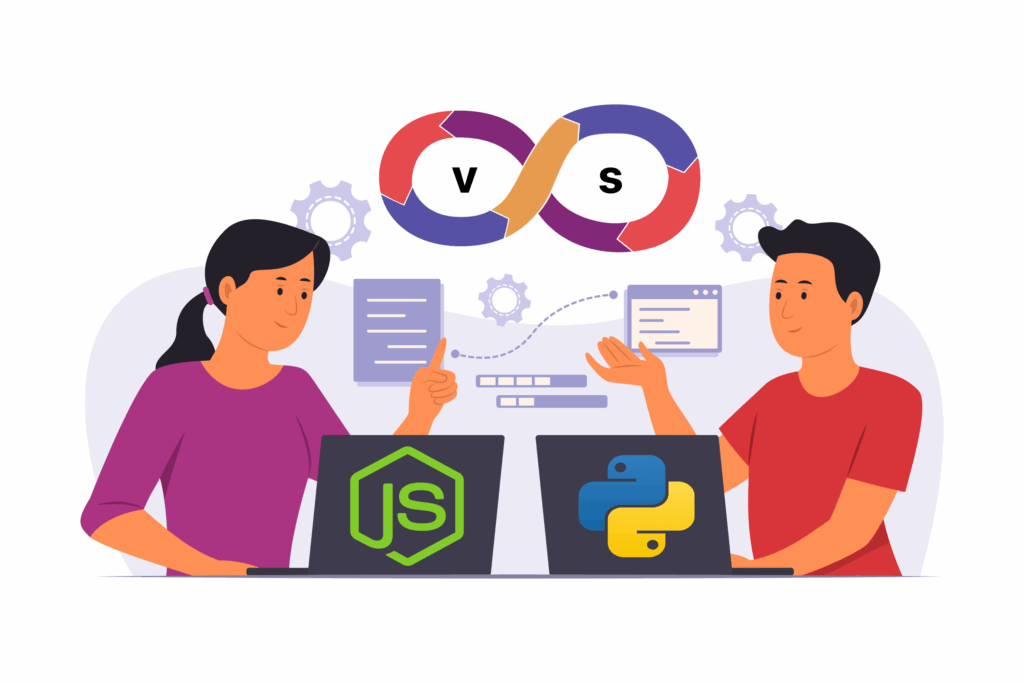
Node.js vs Python — Quick Comparison
| Feature | Node.js | Python |
|---|---|---|
| Performance | Excellent for real-time apps | Slightly slower, better for computation-heavy tasks |
| Learning Curve | Easier if you know JavaScript | Easier for beginners |
| AI/ML Integration | Limited | Strong |
| Real-Time Apps | Perfect with Socket.IO | Requires external libraries |
| Scalability | Very High | Moderate |
| Best For | Chats, Games, APIs, Dashboards | AI, Analytics, Automation |
Real-World Use Cases

Here’s how companies are combining Flutter with Node.js and Python:
Uber / Lyft clones – Real-time ride tracking using Flutter + Node.js
E-commerce apps – Inventory and payment APIs using Flutter + Python (Django REST)
HealthTech apps – Predictive analysis and patient tracking via Flutter + Python (FastAPI)
Chat & Collaboration tools – Instant messaging powered by Flutter + Node.js (Socket.IO)
Best Practices for Flutter Backend Integration
Use REST or GraphQL APIs for communication between Flutter and backend.
Secure your APIs using JWT or OAuth2.
Use Dio or GetConnect in Flutter for efficient networking.
Deploy your backend on scalable platforms like AWS, Google Cloud, or Render.
Use environment configs to manage API keys securely.
Final Thoughts
In 2025, pairing Flutter with Node.js or Python isn’t just smart — it’s essential for building robust, modern, and intelligent apps.
Choose Node.js for performance, scalability, and real-time apps.
Choose Python for AI, analytics, and data-driven applications.
Whichever you pick, you’ll have a future-ready, full-stack Flutter app that’s built to scale and succeed
FAQs
Q1. Can Flutter directly connect to databases without a backend?
No, Flutter cannot directly connect to cloud databases like MySQL or MongoDB. It needs a backend (like Node.js or Python) to handle secure communication.
Q2. Which is faster: Node.js or Python backend for Flutter?
Node.js is generally faster for I/O-heavy or real-time apps, while Python is better for computation or AI tasks.
Q3. Can I use Firebase instead of Node.js or Python?
Yes, Firebase is great for small to medium apps, but Node.js/Python gives more control and flexibility for complex, large-scale systems.
Q4. Which backend is better for AI-powered Flutter apps?
Python — it integrates easily with TensorFlow, OpenAI APIs, and machine learning libraries.
Q5. Is Node.js suitable for enterprise-grade Flutter apps?
Absolutely. Many enterprise apps use Flutter for frontend and Node.js for backend due to performance and scalability.