


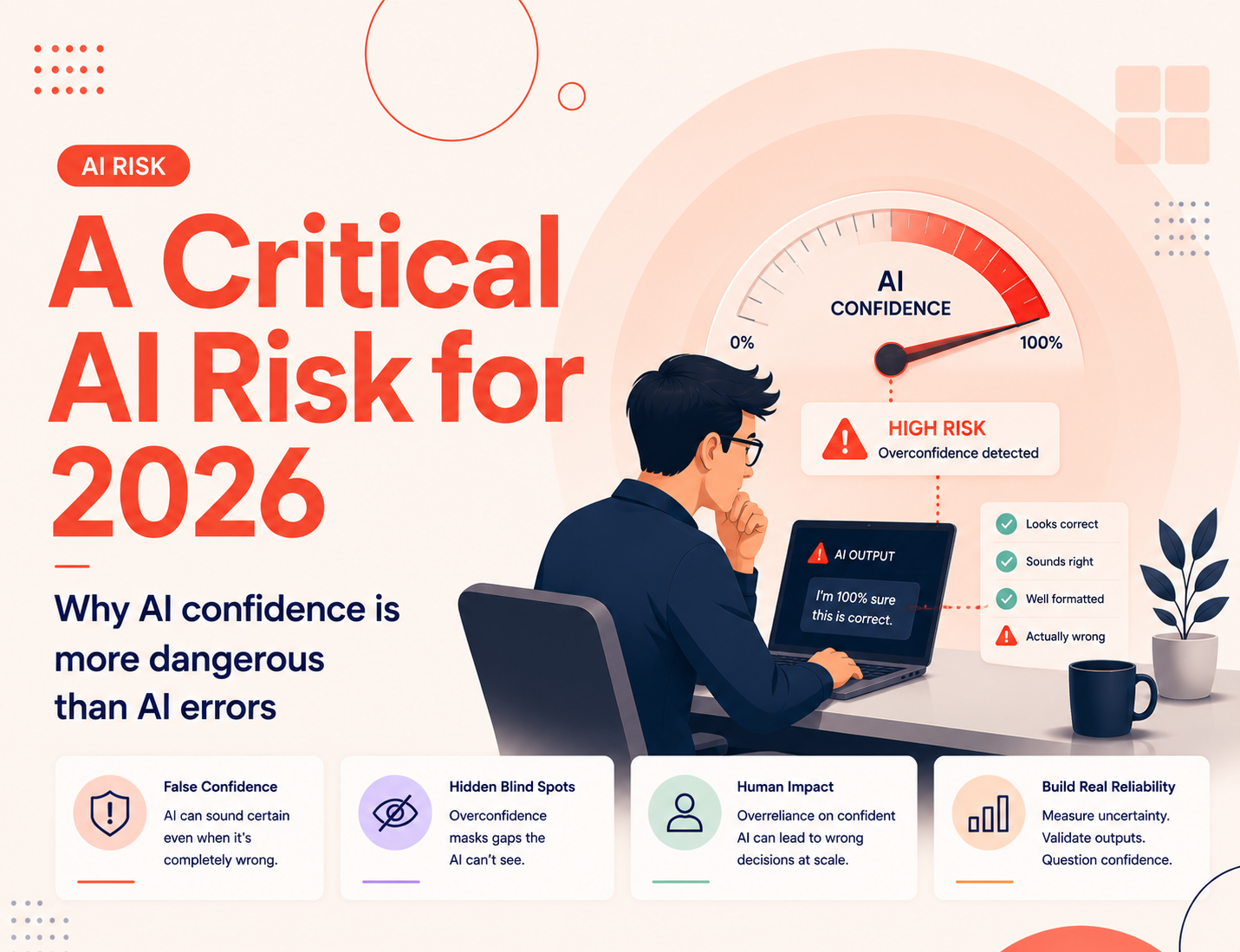
Introduction: The Real AI Risk Nobody Is Measuring
Most conversations about artificial intelligence focus on errors—wrong answers, hallucinations, or technical failures. But in 2026, the most dangerous AI systems are not the ones that fail loudly. They are the ones that act with absolute confidence while being wrong.
AI confidence is becoming a silent risk multiplier. When systems sound certain, decisive, and authoritative, humans stop questioning them. This shift changes AI from a tool into an unchallenged decision-maker.
What Do We Mean by AI Confidence?
AI confidence is not accuracy. It is the perceived certainty with which a system presents its output.
Confident AI systems:
- Deliver answers without hesitation
- Avoid expressing uncertainty
- Use authoritative language
- Trigger automated actions
The problem is simple: confidence scales faster than correctness.
Why AI Errors Are Easier to Detect Than AI Confidence
Errors often produce friction:
- Results look wrong
- Outputs conflict with expectations
- Systems trigger alerts
Confidence, however, hides mistakes:
- Outputs appear polished and convincing
- Users trust the system’s authority
- Errors propagate silently across systems
In many cases, AI confidence prevents human intervention entirely.
How Overconfident AI Systems Create Systemic Risk
1. Automation Bias
Humans naturally defer to confident machines, especially under time pressure.
2. Error Amplification
Confident decisions spread quickly across dependent systems.
3. Suppressed Human Judgment
Users stop double-checking outputs they believe are “intelligent.”
Real-World Impact Areas in 2026
Healthcare
Confident AI diagnoses can override clinical intuition, delaying critical interventions.
Finance
Trading and risk models acting with certainty can trigger cascading losses.
Autonomous Systems
Vehicles and robots that fail to signal uncertainty increase safety risks.
Enterprise Decision-Making
Executives may rely on confident AI forecasts without scrutiny.
Why Current AI Metrics Fail to Capture This Risk
Most evaluation frameworks measure:
- Accuracy
- Precision and recall
- Latency
They do not measure:
- Confidence calibration
- Uncertainty signaling
- Human trust impact
This blind spot allows overconfident systems to pass validation checks.
The Difference Between Safe AI and Confident AI
Safe AI systems:
- Express uncertainty clearly
- Slow down under ambiguity
- Escalate to humans
Overconfident AI systems:
- Mask uncertainty
- Optimize for fluency
- Push decisions forward
In 2026, trustworthiness will matter more than performance.
How AI Systems Should Handle Uncertainty
Confidence Calibration
Align confidence levels with actual reliability.
Explicit Uncertainty Signals
Expose probability ranges and risk scores.
Decision Thresholds
Delay or block actions below confidence thresholds.
Human-in-the-Loop Design
Require confirmation for high-impact decisions.
What This Means for Developers and AI Teams
Teams must shift from asking:
- “Is the model accurate?”
to:
- “Does the model know when it might be wrong?”
Future AI engineering will prioritize humility over certainty.
Regulatory Pressure Is Coming
Emerging AI regulations increasingly focus on:
- Explainability
- Risk disclosure
- Accountability for automated decisions
Overconfident AI systems will struggle to meet compliance requirements.
Final Thoughts
AI errors are visible. AI confidence is persuasive.
As artificial intelligence becomes more autonomous in 2026, the greatest risk will not be machines that fail—but machines that never admit uncertainty.
The future of responsible AI lies not in smarter answers, but in honest ones.
FAQs
Q: Is AI confidence the same as hallucination?
No. Hallucinations are incorrect outputs; confidence is how strongly they are presented.
Q: Can confidence be controlled in AI systems?
Yes, through calibration, thresholds, and uncertainty-aware design.
Q: Why does this matter more in 2026?
Because AI systems are moving from advisory roles to autonomous decision-makers.