


Introduction
One of the most common questions Flutter developers face is: Which state management solution should I use?
Since Flutter’s early days, developers have moved from basic setState() to more advanced approaches like Provider, Riverpod, and Bloc. Each solution has its strengths, trade-offs, and best-fit scenarios.
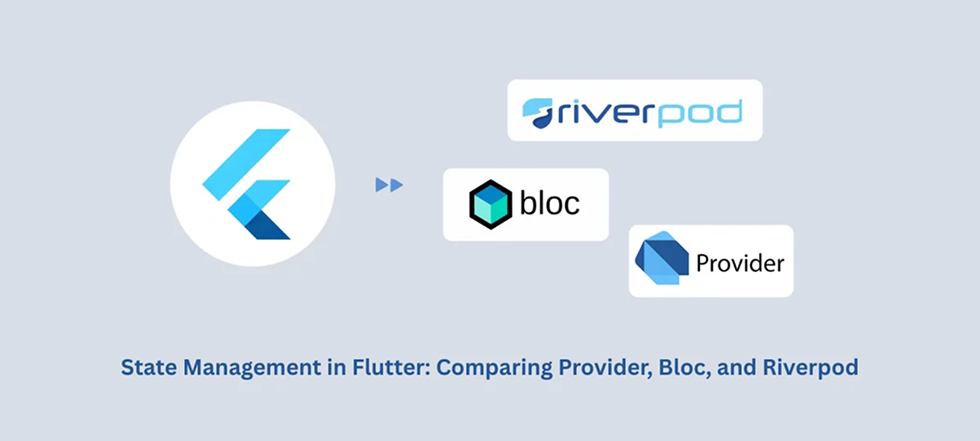
In this blog, we’ll break down these three popular state management options, compare them side by side, and help you decide which one is right for your next Flutter project.
Understanding State Management in Flutter

State management is at the heart of every Flutter app.
Ephemeral state: short-lived, UI-specific state (e.g., text field input).
App-wide state: shared data across multiple widgets (e.g., user authentication, cart items).
The right state management solution ensures your app is scalable, maintainable, and performant.
Provider – The Officially Recommended Solution
Provider is one of the first widely adopted state management solutions for Flutter.
✅ Pros:
Simple and beginner-friendly
Backed by the Flutter team
Works well with ChangeNotifier
❌ Cons:
Can become verbose in complex apps
Requires boilerplate code
Tightly coupled with Flutter’s
BuildContext
🎯 Best use cases:
Small-to-medium apps
Prototypes & personal projects
Beginners learning state management
Riverpod – The Modern Alternative
Riverpod was designed as an improvement over Provider. It eliminates many of Provider’s limitations while keeping its simplicity.
✅ Pros:
Compile-time safety (errors caught before runtime)
No dependency on
BuildContextHighly testable and flexible
Better performance with large-scale apps
❌ Cons:
Relatively newer, smaller ecosystem than Provider/Bloc
Slight learning curve for beginners
🎯 Best use cases:
Medium-to-large projects
Apps requiring scalability and flexibility
Developers who want a modern and future-proof solution
Bloc – Enterprise-Level Robustness
Bloc (Business Logic Component) is one of the most structured state management patterns in Flutter. It uses events and states to ensure predictable flows.
✅ Pros:
Clear separation of concerns
Predictable state transitions
Strong community adoption for enterprise use
Scales well for large teams and complex projects
❌ Cons:
Steeper learning curve
More boilerplate than Provider or Riverpod
Can feel “overkill” for small apps
🎯 Best use cases:
Enterprise apps with complex business logic
Fintech, healthcare, and mission-critical apps
Large teams requiring strict architecture
Provider vs Riverpod vs Bloc — Side-by-Side Comparison
| Feature | Provider | Riverpod | Bloc |
|---|---|---|---|
| Learning Curve | Easy | Medium | Hard |
| Boilerplate | Medium | Low | High |
| Performance | Good | Excellent | Good |
| Testability | Average | Excellent | Excellent |
| Ecosystem Support | Strong | Growing | Strong |
| Best For | Beginners, small apps | Scalable apps, flexibility | Enterprise, strict logic |
Which State Management Should You Choose?
✅ For beginners or small apps → Provider
✅ For modern, scalable apps → Riverpod
✅ For enterprise projects & large teams → Bloc
Real-world scenarios:
Building a to-do app for learning? → Provider
Developing a social media app? → Riverpod
Creating a banking or healthcare app? → Bloc
Best Practices for Flutter State Management
Keep business logic separate from UI
Use immutable states where possible
Write unit tests for critical state transitions
Don’t over-engineer — match the solution to the project’s complexity
Conclusion
There’s no “one-size-fits-all” answer for Flutter state management.
Provider is great for beginners and smaller apps.
Riverpod brings modern improvements and flexibility for scalable apps.
Bloc ensures predictable state flows and is ideal for enterprise-level apps.
👉 The best advice? Try them out, experiment, and choose based on your project size, team structure, and long-term goals.
FAQs
Q1: Which is faster, Provider, Riverpod, or Bloc?
Riverpod generally offers better performance due to compile-time safety and reduced boilerplate.
Q2: Can I mix different state management solutions in one Flutter project?
Yes — many apps mix solutions (e.g., Provider for simple state + Bloc for complex business logic).
Q3: Is Provider being replaced by Riverpod?
No, Provider is still widely used, but Riverpod is considered a modern alternative.
Q4: Do I need Bloc for small apps?
Not really — Bloc is best for complex, large-scale projects.